
 Managed IT Services
 Business Continuity (BCDR)
 Cloud Telephony
 Managed Infrastructure
 Microsoft Azure
 Microsoft Teams Phone
 Cyber Security Services
 Microsoft 365 For Business
 Brisbane
 Aviation
 Healthcare
 Field Service
 Finance
 Manufacturing
 Small Business
 Legal
Legal Travel
Cyber Insurance in Australia: Costs, Coverage & Security Requirements
August 14, 2026by Levit8 IT Solutions

Cyber insurance in Australia can help businesses manage some of the financial consequences of a cyber incident. However, what a policy covers, what it costs and what insurers consider during underwriting can vary significantly.
For businesses applying for cyber insurance or preparing for renewal, the conversation can also extend to cybersecurity. Insurers may ask about controls such as multi-factor authentication (MFA), patching, backups and incident response when assessing risk.
Cyber insurance and cybersecurity ultimately address different parts of that risk. This guide explains cyber insurance costs and coverage in Australia, the security controls insurers may consider, and how businesses can strengthen their cybersecurity before applying or renewing.
Note: Levit8 provides managed IT and cybersecurity services, not insurance, financial or legal advice. Insurance coverage, policy terms and suitability should be discussed with an appropriately qualified insurance professional.
KEY TAKEAWAYS
- Cyber insurance transfers certain defined financial risks after an incident; it does not prevent incidents or reduce your exposure to them.
- Exact coverage, exclusions and premiums vary significantly by insurer and policy, so read your policy wording carefully rather than relying on general assumptions.
- Insurers may ask questions about your security controls during underwriting, but no single control guarantees eligibility, lower premiums or claim acceptance.
- Reviewing your cybersecurity posture before applying or renewing can help identify gaps in the controls and information that may be relevant during underwriting.
What Is Cyber Insurance?
Cyber insurance is designed to help businesses manage certain financial losses and response costs associated with cyber incidents. The Insurance Council of Australia notes that cyber policies can provide assistance with areas such as forensic investigation and data restoration, although the exact coverage depends on the individual policy.
Coverage can vary significantly between insurers and policies. Businesses should therefore review the actual policy wording, limits, conditions and exclusions rather than assuming that every cyber insurance policy provides the same protection.
First-Party vs Third-Party Cyber Cover
Cyber policies typically distinguish between first-party cover, which relates to costs and losses your own business incurs, and third-party cover, which relates to claims made against you by others, such as affected customers or partners. Some policies include both, while others focus more heavily on one.
First-party and third-party cover can also contain different limits, conditions and exclusions. The exact protection available depends on the individual policy, so businesses should confirm how each type of cover applies to their circumstances.
How Does Cyber Insurance Work in Australia?
Cyber insurance in Australia generally begins with an application and underwriting process. Businesses may be asked about their industry, revenue, data exposure, previous incidents and cybersecurity controls before an insurer determines the policy terms and premium it is prepared to offer.
If a covered cyber incident occurs, the business follows the notification and claims process specified by its policy. The insurer then assesses the incident and resulting losses against the policy’s coverage, limits, conditions and exclusions.
Why Your Cybersecurity Posture Can Enter the Conversation
Insurers may ask about security controls because these safeguards can influence an organisation’s exposure to cyber incidents. This doesn’t mean specific controls are mandatory across the market. Instead, security controls may form part of a broader underwriting assessment.
This creates an important connection between cyber insurance and cybersecurity. The controls a business uses to reduce cyber risk can also form part of the information considered during underwriting.
What Can Cyber Insurance Cover?
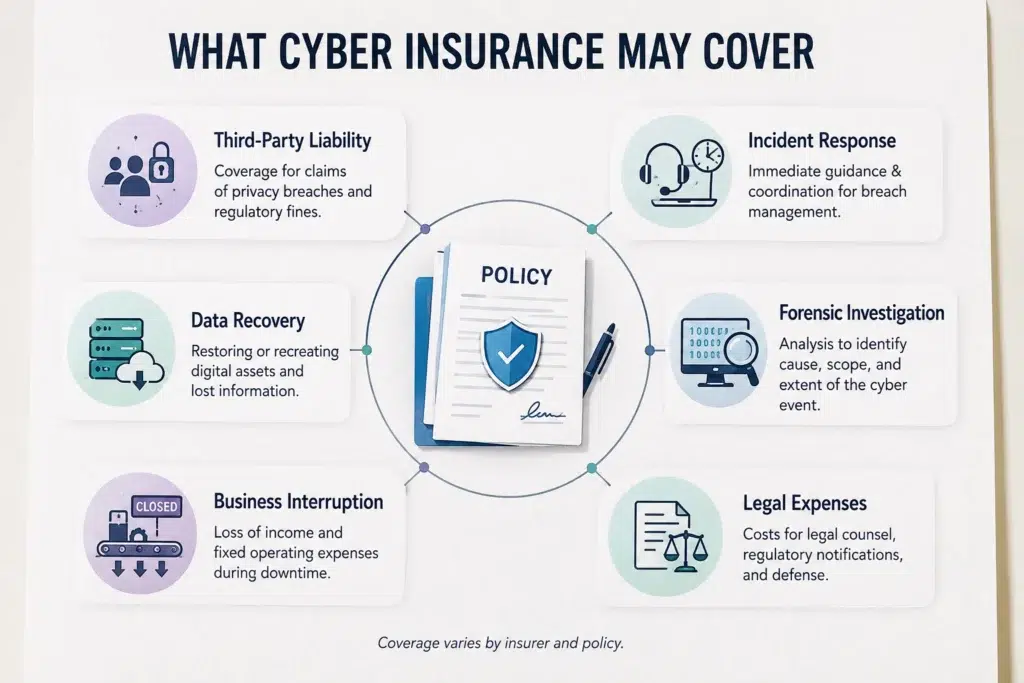
Coverage varies by policy, but cyber insurance may include incident response and forensic investigation costs, legal expenses, business interruption losses, data recovery costs and certain third-party liability claims.
Some policies may also address cyber extortion and other incident-related costs, subject to their specific terms, limits and exclusions.
Whether any of these apply to your business, and to what extent, depends entirely on your specific policy. Businesses should not assume that commonly advertised forms of cyber insurance coverage are automatically included in every policy.
What May Not Be Covered?
Cyber insurance exclusions vary between insurers and policies. A policy may also contain specific limits, sub-limits, definitions and conditions that affect whether particular losses or response costs are covered.
Businesses should review these details carefully rather than relying on a general list of cyber insurance exclusions. The policy wording and advice from an appropriately qualified insurance professional should guide any coverage decision.
How Much Does Cyber Insurance Cost in Australia?
The cost of cyber insurance in Australia varies because insurers price policies according to the risk profile of the business and the cover being requested. There is therefore no single premium that accurately represents every Australian organisation.
Instead of relying on a generic price, businesses should understand the factors that can influence cyber insurance costs and obtain pricing based on their own circumstances.
What Can Affect Cyber Insurance Costs?
Factors that may influence cyber insurance premiums include:
- Business size and revenue
- Industry and the sensitivity of data handled
- Volume and type of data exposure
- Claims history
- Coverage limits requested
- Excess or deductible chosen
- Overall policy structure
- Cybersecurity posture and controls in place
Cybersecurity posture can be one part of the underwriting assessment, alongside the organisation’s size, industry, exposure and requested coverage. Strong controls should not be treated as a guarantee of lower cyber insurance premiums.
How Much Cyber Insurance Does a Business Need?
The appropriate amount of cyber insurance depends on factors such as the organisation’s financial exposure, data holdings, operational dependencies and the type of cover being considered. There is no universal coverage limit that suits every Australian business.
Determining an appropriate limit is an insurance decision and should be discussed with an appropriately qualified insurance professional who can assess the organisation’s circumstances.
What Cybersecurity Controls Might Insurers Ask About?
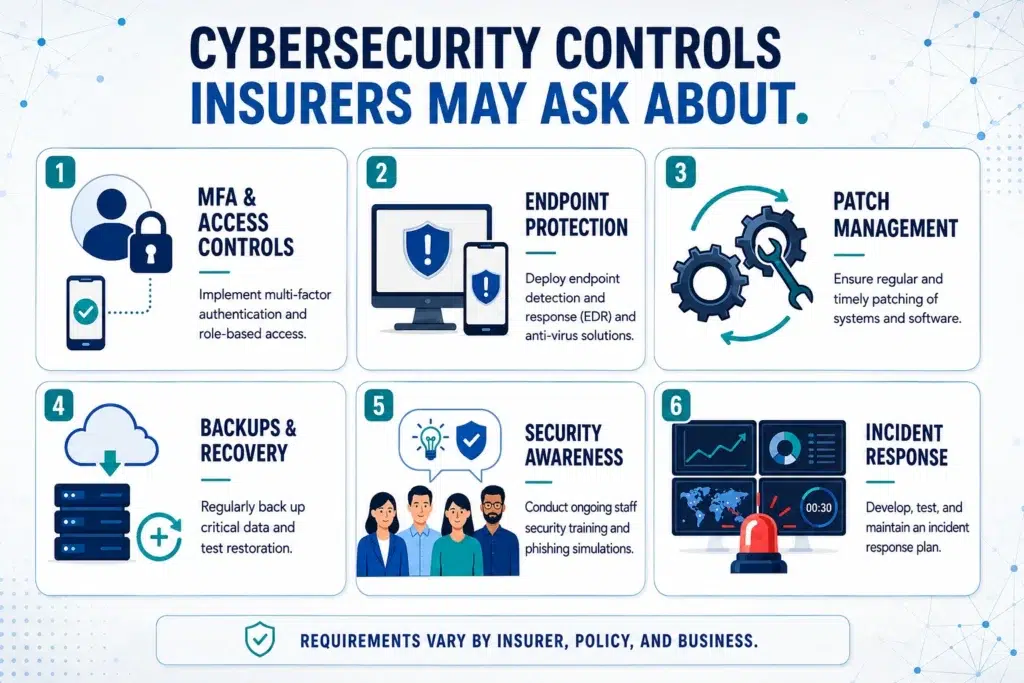
Cyber insurance underwriting can include questions about the controls a business uses to prevent, detect and recover from cyber incidents. The exact questions vary between insurers and policies, but several security areas commonly form part of broader cyber risk assessments.
Multi-Factor Authentication and Access Controls
Insurers may ask where multi-factor authentication is enabled, particularly across email, remote access, administrator accounts and other critical systems. Businesses should also understand who holds privileged access and whether those permissions are still necessary.
MFA is valuable beyond insurance because it adds another layer of protection when passwords are stolen or compromised. Levit8’s guide to multi-factor authentication explains how the control works and where businesses can use it.
Endpoint Protection and Patch Management
Devices and software can become attack paths when vulnerabilities remain unpatched or systems fall out of support. Businesses should know how endpoints are protected, how updates are managed and whether critical vulnerabilities are being addressed consistently.
Secure Backups and Recovery Testing
Having backups is not the same as knowing the business can recover from them. Organisations should understand what is backed up, how those backups are protected and when recovery was last successfully tested.
This becomes particularly important when ransomware or operational disruption affects critical systems. Strong backup and recovery management can help businesses restore critical systems and data after a disruptive incident. Regular recovery testing also helps confirm that backups will work when they are actually needed.
Email Security, Staff Awareness and Monitoring
Cyber risk is not limited to technical vulnerabilities. Businesses should also review phishing protections, employee security awareness and whether suspicious activity across important systems can be detected and investigated.
Incident Response Planning
When an incident occurs, teams need to know who makes decisions, who gets contacted and how the response is escalated. A documented incident response process can reduce confusion during the first critical hours of an event.
These controls should not be interpreted as universal cyber insurance requirements in Australia. What an insurer asks about depends on the policy, organisation and underwriting process, while cybersecurity guidance from authorities such as the ASD serves a different purpose.
Essential Eight and Cyber Insurance: What’s the Relationship?
The Essential Eight is a set of cybersecurity mitigation strategies developed by the Australian Signals Directorate (ASD). It addresses areas including patching, multi-factor authentication, backups, application control and restricting administrative privileges.
Several of these areas overlap with controls that may also appear in cyber insurance underwriting discussions. However, the Essential Eight was designed to improve cybersecurity resilience, not to function as an insurance standard.
What Essential Eight Maturity Does Not Guarantee
Essential Eight maturity does not automatically qualify a business for cyber insurance, guarantee lower premiums or determine whether a future claim will be accepted. Individual insurers establish their own underwriting requirements and policy conditions.
Businesses should therefore use the Essential Eight for its intended purpose: strengthening cybersecurity maturity and reducing exposure to common attack techniques.
How to Prepare Before Applying for or Renewing Cyber Insurance
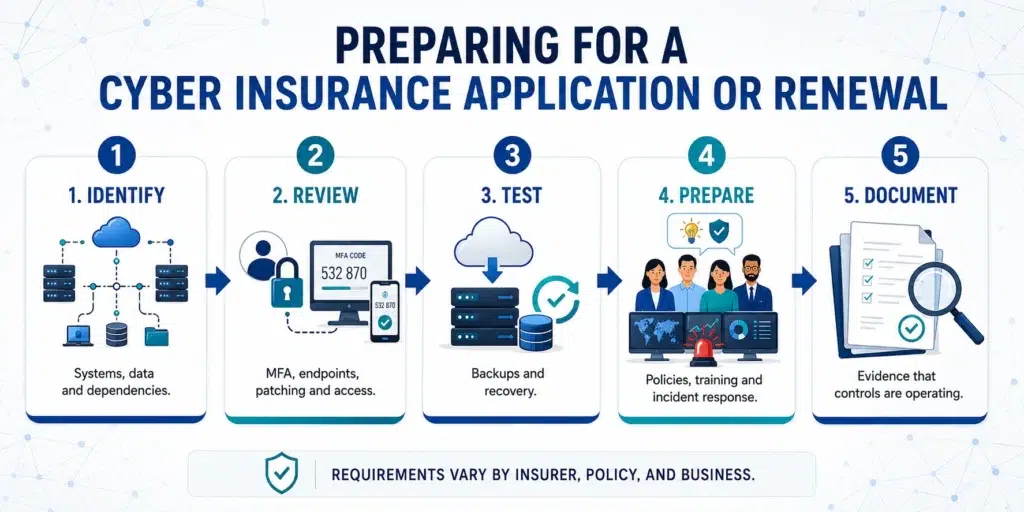
Before applying for or renewing cyber insurance, businesses should know what security controls they actually have in place and whether those controls are working as intended. An underwriting questionnaire is not the ideal time to discover gaps in MFA coverage, patching or backup recovery testing.
Know What Systems and Data You Need to Protect
Start with the basics: what systems keep the business operating, what sensitive data you hold, where that data lives and which third parties can access it. This gives the business a clearer picture of what would actually be affected by a cyber incident.
Include cloud platforms, employee devices, critical applications and external providers rather than looking only at servers sitting inside the business.
Review Whether Core Security Controls Are Actually Operating
Don’t stop at asking whether the business “has MFA” or “uses endpoint protection.” Check whether those controls are enabled across the accounts, devices and systems they are supposed to protect.
Review administrator access, patch status, endpoint protection, email security and MFA coverage. Any gaps between documented security controls and what is actually operating should be addressed before completing an underwriting questionnaire.
Verify Your Backups and Recovery Capability
Check when the business last completed a successful restore, not simply whether the backup dashboard says everything is green. Confirm that critical data is being captured, backups are appropriately protected and the recovery process actually works.
A backup that cannot be restored when needed provides very little resilience during ransomware, system failure or another disruptive incident.
Review Policies, Training and Incident Preparedness
Review when employees last received cybersecurity awareness training and whether responsibilities during a cyber incident are clearly documented. Staff should know how to report suspicious activity and who needs to be involved when an incident escalates.
The incident response plan should also reflect how the business operates today, not the team structure or technology environment from two years ago.
Gather Evidence That Controls Are Working
Finally, make sure the business can demonstrate that important controls are actually operating. Depending on the environment, that could include MFA status, patching records, backup test results, security reports, training records and documented access reviews.
If you’re unsure where those gaps are, a Cyber Security Health Check can provide a structured review of your current security posture before your next insurance conversation or renewal.
Cybersecurity also shouldn’t become a once-a-year exercise performed immediately before renewal. Users change, new devices appear, vulnerabilities emerge and controls can quietly stop working as the technology environment evolves.
Continue reviewing access, patching, backups, MFA, monitoring and staff awareness throughout the year. Maintaining evidence of those controls also gives the business a more accurate picture of its security posture when the next renewal arrives.
Cyber Insurance Does Not Replace Cybersecurity
Cyber insurance and cybersecurity address different sides of the same business risk. Insurance can help manage certain financial consequences after an incident, while cybersecurity focuses on reducing the likelihood, exposure and operational impact of that incident in the first place.
A cyber insurance policy cannot patch an exposed system, enforce MFA, secure an endpoint, train an employee or restore a failed backup. Australia’s Cyber.gov.au guidance similarly emphasises that cyber insurance is not a substitute for investing in cybersecurity protections.
This is where ongoing managed cyber security services can complement financial risk-transfer measures such as insurance. Continuous monitoring, security controls, patching, access management and preparedness help businesses reduce exposure and respond more effectively when cyber incidents occur.
For Australian businesses, the strongest approach is therefore not cyber insurance or cybersecurity. They perform different jobs and should be considered complementary parts of broader cyber risk management.
Businesses that need ongoing support maintaining these controls can use managed cyber security services to strengthen monitoring, protection and security management over time.
Cyber Insurance and Australian Data Breach Responsibilities
Cyber insurance does not replace an organisation’s legal or regulatory responsibilities following a data breach. Australian organisations covered by the Privacy Act may have notification obligations under the Office of the Australian Information Commissioner’s Notifiable Data Breaches (NDB) scheme when an eligible data breach occurs.
Businesses should understand how potential incidents are escalated internally so reporting requirements can be assessed promptly. For specific obligations, use current OAIC guidance or seek appropriate legal advice.
Cyber Insurance Readiness Checklist for Australian Businesses
Before applying for or renewing a policy, it’s worth reviewing:
- Do you know what data and systems you’re trying to protect?
- Is MFA active across email, remote access and critical systems?
- Are endpoints protected and patched on a regular schedule?
- Are backups running, isolated and regularly tested for recovery?
- Has your team had recent security awareness training?
- Do you have a documented, realistic incident response plan?
- Can you produce evidence that these controls are operating, not just documented?
- Have you reviewed your policy’s specific coverage and exclusions with a broker?
Use this checklist as a starting point before your next cyber insurance application or renewal. Any gaps you uncover are worth addressing as part of your broader cybersecurity program, regardless of the eventual insurance decision.
Read More
- What Are Managed Cyber Security Services?
- Multi-Factor Authentication Made Simple
- Cyber Security for Small Businesses
Frequently Asked Questions
What does cyber insurance cover in Australia?
Coverage varies by insurer and policy, but can include costs like incident response, legal support, business interruption and certain liability claims. Always confirm specifics against your own policy wording.
What does cyber insurance not cover?
Cyber insurance exclusions vary by policy and may be affected by specific definitions, conditions, limits and sub-limits. Check the wording of your individual policy rather than relying on a general list of exclusions.
How much does cyber insurance cost in Australia?
There’s no fixed figure. Pricing depends on factors like business size, industry, data exposure, claims history, coverage limits and security posture, assessed individually by each insurer.
Does MFA guarantee cyber insurance eligibility?
No. MFA is a control insurers may ask about, but it doesn’t guarantee eligibility, lower premiums or claim acceptance on its own.
Does Essential Eight compliance guarantee cyber insurance?
No. The Essential Eight is an Australian cybersecurity framework designed to improve cyber resilience, not an insurance certification. Essential Eight maturity does not automatically guarantee insurance eligibility, lower premiums or claim acceptance.
How much cyber insurance does my business need?
This depends on your specific risk profile and should be worked through with a qualified insurance broker or adviser, not determined from general guidance.
Strengthen Your Cybersecurity Before Your Next Renewal
Cyber insurance can help manage certain financial consequences of a cyber incident, but it cannot prevent the incident itself. Strong cybersecurity reduces exposure, strengthens resilience and helps your business understand where its most important security gaps remain.
If you’re preparing for a cyber insurance application or renewal, Levit8’s cyber security services can help you review your current cybersecurity posture and identify practical opportunities to strengthen your protection.
Author
Levit8 IT Solutions
Levit8 is a leading Australian managed IT services provider, helping businesses across industries improve performance, boost security, and scale confidently through smart, reliable technology. With a passion for efficiency, security, and client success, our local team delivers expert support, enterprise-grade solutions, and a no-nonsense approach to IT. We empower small and mid-sized businesses with future-proof systems, robust cybersecurity, and seamless support—so technology becomes an asset, not a headache.