
 Managed IT Services
 Business Continuity (BCDR)
 Cloud Telephony
 Managed Infrastructure
 Microsoft Azure
 Microsoft Teams Phone
 Cyber Security Services
 Microsoft 365 For Business
 Brisbane
 Aviation
 Healthcare
 Field Service
 Finance
 Manufacturing
 Small Business
 Legal
Legal Travel
Cyber Incident Response Plan for Australian Businesses: Steps, Roles & Checklist
August 18, 2026by Levit8 IT Solutions

Most businesses only discover the gaps in their incident response plan once an incident is already underway. Roles are unclear, nobody knows who can make critical decisions, and the “plan” turns out to be a document nobody has opened in two years.
A cyber incident response plan sets out how your business identifies, escalates, contains and recovers from a cyber incident. This guide explains what Australian businesses should include in the plan, who should be responsible, and what needs to happen in the first hours of an incident.
KEY TAKEAWAYS
- A cyber incident response plan defines roles, escalation paths and procedures before an incident happens, not during one.
- A proper response covers identification, escalation, containment, investigation, recovery and review.
- Responding to a cyber incident involves business decisions as much as technical ones.
- Incident response plans should be tested regularly, not just written and filed away.
- Serious incidents can require specialist external incident response expertise beyond day-to-day IT support.
What Is a Cyber Incident Response Plan?
Cyber incident response is the process of detecting, assessing and responding to a cyber security incident, from the first sign that something is wrong through to recovery. A cyber incident response plan documents who is involved, what actions they take and how the response is coordinated.
An incident response plan is different from a backup strategy, general cyber security policy or business continuity and disaster recovery plan. These measures can support incident response, but the response plan specifically defines what happens when a cyber incident is suspected or confirmed.
Incidents that would typically activate a response plan include:
- ransomware
- compromised user accounts
- business email compromise
- malware infections
- unauthorised access to systems or data
- suspected data breaches
Why Australian Businesses Need a Cyber Incident Response Plan
A cyber incident rarely stays contained to IT. Disrupted systems can prevent staff from working, interrupt customer service and affect normal business operations.
A documented response plan gives the people involved clear responsibilities and escalation paths. Instead of deciding what to do under pressure, the business already has an agreed process to follow.
A cyber incident can also raise questions about what information may have been accessed or exposed. Australia’s Notifiable Data Breaches (NDB) scheme sets out when eligible data breaches involving personal information must be notified to affected individuals and the Office of the Australian Information Commissioner.
Not every cyber incident triggers the NDB scheme. Whether notification obligations apply depends on the circumstances of the incident and should be assessed appropriately rather than assumed.
A response plan also helps ensure decisions are made by the right people at the right time. The Australian Signals Directorate’s Australian Cyber Security Centre (ASD’s ACSC) provides guidance and resources to help organisations prepare for and manage cyber security incidents.
That preparation matters because incident response is not something a business should be designing for the first time while an incident is unfolding.
What Should a Cyber Incident Response Plan Include?
A useful plan is specific enough that someone under pressure can follow it without having to interpret vague instructions. Here’s what that looks like in practice.
Incident Categories and Severity Levels
Not every unusual login attempt is a crisis, and an incident response plan should not treat every alert as one. Define clear categories for a security alert, suspected incident and confirmed incident, along with the criteria used to move an event from one level to the next.
A consistent security alert management process helps teams investigate suspicious activity before deciding whether the incident response plan needs to be activated. Clear severity levels also prevent minor alerts from triggering unnecessary escalation.
Roles and Responsibilities
Every plan needs clear ownership of the technical response, business decisions, communications, documentation and external escalation. Each responsibility should be assigned before an incident occurs.
Smaller businesses may combine several of these responsibilities across one or two people, supported by an external IT or cyber security provider where appropriate. What matters is that responsibility is clearly assigned rather than decided during the incident.
Businesses without dedicated internal security resources can also use managed cyber security to support ongoing monitoring, risk management and incident preparedness.
Escalation and Communication Procedures
Your plan should define who gets notified first, who has authority to make critical decisions and when senior management needs to become involved. Those decisions may include isolating systems, interrupting services or escalating the incident to external specialists.
The plan should also include alternative communication methods in case normal channels, such as email or business phone systems, are affected.
Critical Systems and External Contacts
Keep an up-to-date record of critical systems and data, technology providers, recovery contacts and any external specialists the business may need during an incident. Legal or privacy advisers and your cyber insurer or broker may also need to be included depending on your organisation and risk profile.
Cyber insurance in Australia can form part of this response framework, particularly where a policy sets out notification requirements or provides access to external incident support. Those requirements should be understood before an incident occurs, not discovered while one is underway.
What Are the Steps in the Cyber Incident Response Process?
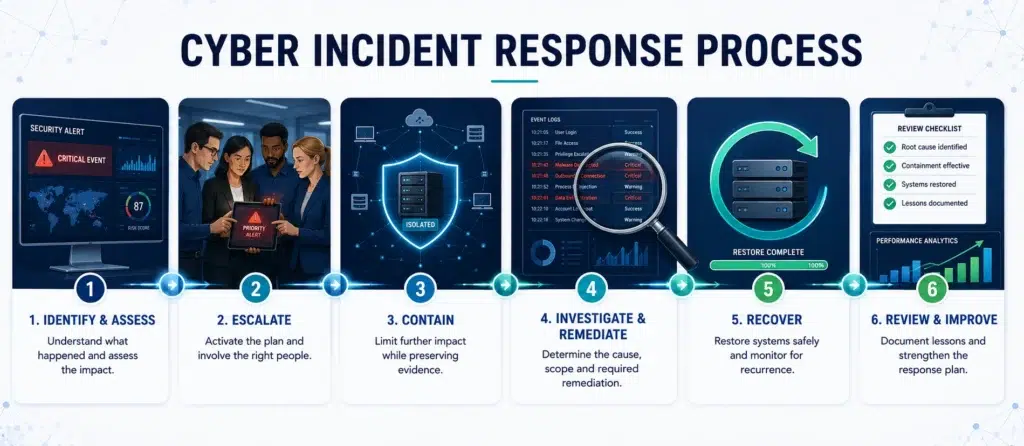
1. Identify and Assess
Determine what has happened and which systems or accounts appear to be affected. Assess the potential severity and business impact based on the information available.
2. Escalate
Activate the plan and bring in the right people, based on the roles you’ve already defined.
3. Contain
Limit the incident from spreading further, which may involve isolating an affected system or restricting a compromised account. At the same time, avoid unnecessarily deleting data or logs that may later be needed to understand the incident.
4. Investigate and Remediate
Investigate the likely cause, affected systems and potential extent of the compromise before addressing the underlying issue. Where the scope is unclear or specialist evidence collection is required, the business may need dedicated incident response or digital forensics expertise.
5. Recover
Restore affected systems carefully and validate that they are safe before returning them to normal operation. Continue monitoring for signs that the compromise or its effects remain.
Effective recovery also depends on established business continuity and disaster recovery measures, particularly when critical systems or data need to be restored while the wider incident is still being managed.
6. Review and Improve
Document what happened, how the response performed and where gaps appeared. Use those findings to update the incident response plan, security controls and responsibilities before the next exercise or incident.
Who Is Responsible During a Cyber Incident?
| Role | Primary Responsibility |
|---|---|
| Business / Executive Lead | Decisions, priorities and authority |
| IT / Security | Technical coordination |
| Operations | Operational continuity |
| Communications | Internal and external messaging |
| Legal / Privacy | Legal and regulatory guidance where required |
| External Providers | Technical or specialist support within agreed scope |
Smaller organisations may combine several roles across one or two people and use an external IT or cyber security provider for additional technical support. The structure matters less than making sure each responsibility has a clear owner.
Cyber incident response is ultimately a business responsibility, not solely an IT responsibility. Decisions about downtime, communications and risk sit with the organisation even when technical response activities are handled by IT specialists.
What Should You Do in the First Hours of a Cyber Incident?
- Activate the incident response plan.
- Notify the designated incident lead.
- Identify potentially affected accounts, devices and systems.
- Take proportionate steps to limit further impact.
- Preserve relevant logs, records and evidence.
- Document actions and decisions as you go.
- Determine whether specialist assistance is required.
- Escalate insurance, legal or regulatory matters where appropriate.
What Not to Do During a Cyber Incident
- Don’t delete logs or files indiscriminately; they may be needed to understand what happened.
- Don’t assume restoring a backup removes the underlying compromise. If the cause hasn’t been fixed, the problem can come straight back.
- Don’t make uncoordinated external communications before the business has agreed on what’s known and what should be said.
- Don’t treat a serious cyber incident like a routine IT support ticket. It needs the escalation and authority a support queue isn’t built for.
When Do You Need Cyber Security Incident Response Services?
Some incidents require capabilities beyond an organisation’s internal resources or standard IT support. This may include significant ransomware, widespread system compromise, suspected exposure of sensitive data, unclear attack scope, forensic evidence requirements or prolonged operational disruption.
Legal, privacy or regulatory complexity can also require additional specialist support alongside the technical response. In this context, it is important to distinguish managed cyber security from specialist incident response.
Managed cyber security services focus on ongoing risk management, monitoring, security controls and preparedness. These capabilities can help a business reduce exposure, identify potential incidents and maintain the processes needed to escalate them appropriately.
Specialist incident response, often referred to as digital forensics and incident response (DFIR), serves a different purpose. It can involve forensic investigation, evidence acquisition and complex emergency response after a serious incident has occurred.
Organisations reviewing their wider protection after an incident can explore Levit8’s cyber security services for ongoing security management and risk reduction.
Test Your Incident Response Plan Before You Need It
An incident response plan that has never been tested relies on assumptions that may no longer be accurate. Contacts change, staff move roles, systems are replaced and responsibilities can become unclear over time.
A tabletop exercise can test those assumptions without waiting for a real incident. Walking through a scenario such as ransomware or account compromise can reveal missing contacts, unclear responsibilities and inaccessible documentation.
ASD’s ACSC provides resources that organisations can use when planning cyber incident response exercises. Testing should feed directly into updates to the plan rather than becoming a standalone compliance exercise.
Cyber Incident Response Planning Across Australia
Cyber incident response fundamentals do not change simply because a business operates in Sydney, Brisbane, Melbourne or the Gold Coast. What matters is how the response plan reflects the organisation’s systems, people, providers and operational dependencies.
For businesses using external or managed IT services in Sydney, the plan should clearly document which response responsibilities remain internal and which involve the technology provider. The same principle applies to organisations relying on managed IT support in Brisbane, Melbourne or the Gold Coast.
Location matters when determining who supports the business, how services are delivered and which external contacts need to be involved. It should not be used to manufacture different incident response processes where no meaningful difference exists.
Cyber Incident Response Plan Checklist
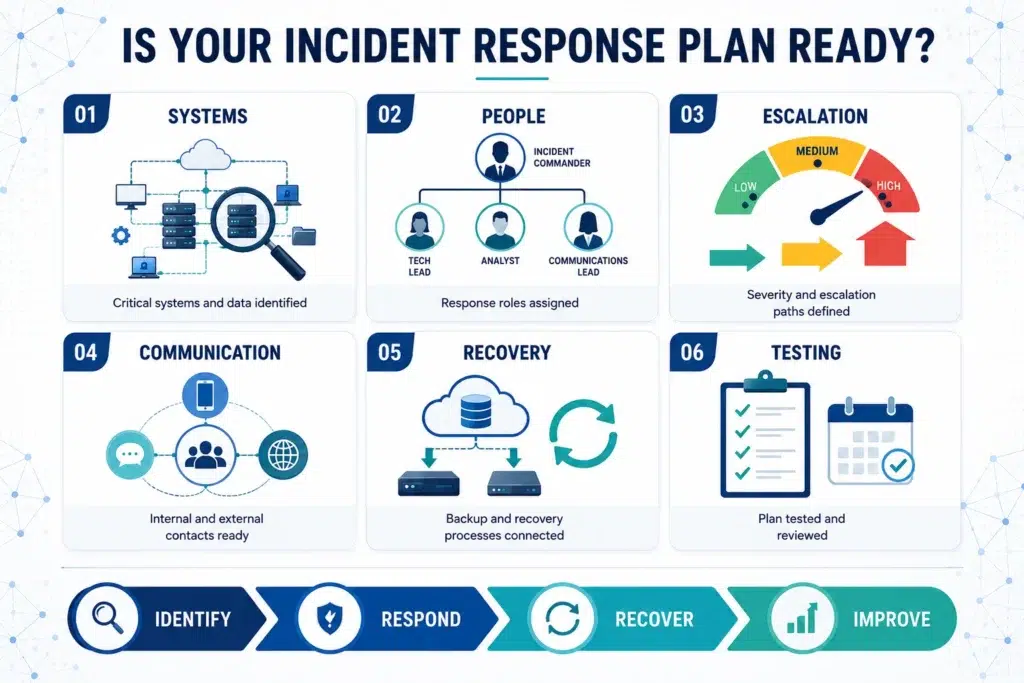
- ☐ Critical systems and data identified
- ☐ Incident categories and severity levels defined
- ☐ Response roles assigned
- ☐ Escalation process documented
- ☐ Internal and external contacts recorded
- ☐ Communication procedures established
- ☐ Alternative communication methods available
- ☐ Containment responsibilities defined
- ☐ Evidence preservation considered
- ☐ Backup and recovery procedures connected
- ☐ Insurance, legal and regulatory contacts documented where relevant
- ☐ Plan accessible during an outage
- ☐ Testing schedule established
- ☐ Post-incident review process defined
Read More
- Cyber Insurance in Australia: What Businesses Need to Know
- Essential Eight Security Audit: A Guide for Australian Businesses
- Cyber Security for Small Businesses in Australia
Frequently Asked Questions
What is a cyber incident response plan?
A documented process that sets out how a business identifies, escalates, contains, investigates and recovers from a cyber security incident, along with who’s responsible at each stage. It’s prepared before an incident, not during one.
What are the stages of cyber incident response?
The main stages are identification and assessment, escalation, containment, investigation and remediation, recovery, and review. Each stage helps the business control the incident, restore operations and improve its response to future incidents.
Who is responsible for cyber incident response?
The business as a whole, not just IT. Executive leadership makes business decisions, IT handles technical coordination, and other roles cover communications, documentation and any external escalation needed.
How often should a cyber incident response plan be reviewed?
Review the plan after significant changes to systems, staff, providers or business operations, as well as after an incident or response exercise. Periodic testing can also help identify outdated contacts, responsibilities and assumptions before they cause problems during a real incident.
When should a business use cyber security incident response services?
When an incident exceeds internal or standard IT support capability, such as significant ransomware, unclear attack scope, potential data exposure, or a need for forensic investigation and evidence collection.
Strengthen Your Cyber Security Before an Incident Happens
A cyber incident response plan gives your business a structured way to act when something goes wrong. But response planning works best alongside the monitoring, security controls and ongoing risk management that reduce the likelihood and impact of incidents in the first place.
Levit8’s managed cyber security services help Australian businesses strengthen that ongoing security foundation, while our broader cyber security services can help identify where current controls, processes and preparedness may need improvement.
Author
Levit8 IT Solutions
Levit8 is a leading Australian managed IT services provider, helping businesses across industries improve performance, boost security, and scale confidently through smart, reliable technology. With a passion for efficiency, security, and client success, our local team delivers expert support, enterprise-grade solutions, and a no-nonsense approach to IT. We empower small and mid-sized businesses with future-proof systems, robust cybersecurity, and seamless support—so technology becomes an asset, not a headache.